


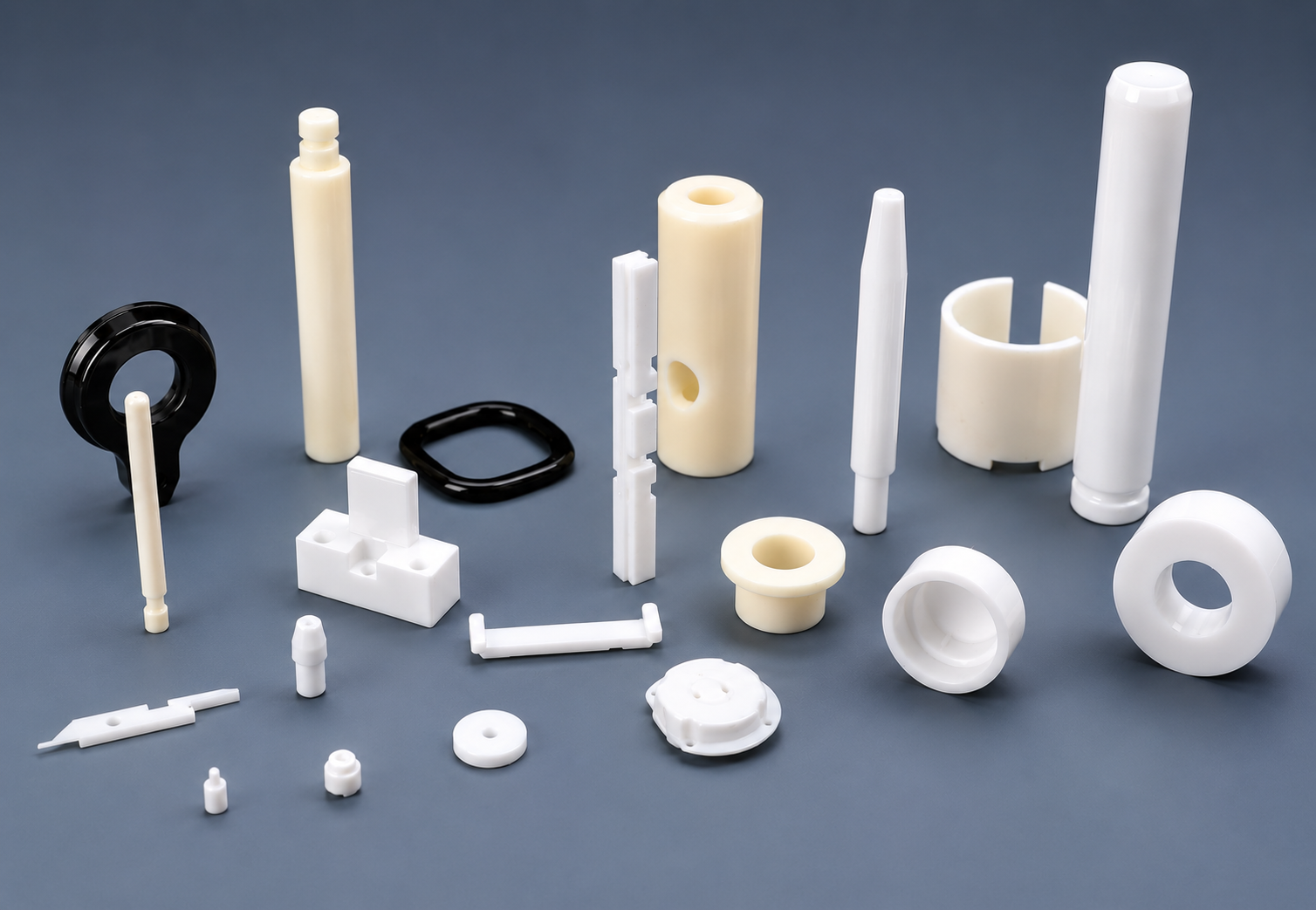
Las piezas cerámicas personalizadas se utilizan a menudo cuando los componentes metálicos o plásticos convencionales no pueden satisfacer los requisitos de resistencia al desgaste, aislamiento eléctrico, estabilidad a altas temperaturas, resistencia a la corrosión o rendimiento dimensional a largo plazo.
En muchas aplicaciones industriales, las piezas cerámicas no se seleccionan solo por su dureza, sino porque pueden combinar varias ventajas funcionales en un solo componente. Una pieza cerámica puede necesitar resistir el desgaste, mantener el aislamiento, permanecer estable bajo el calor, evitar la corrosión o soportar movimientos precisos dentro de un conjunto más grande.
Pero las piezas cerámicas personalizadas también son diferentes de las piezas mecanizadas de metal. Los materiales cerámicos son duros y estables, pero también quebradizos. Características como paredes delgadas, esquinas afiladas, agujeros pequeños, tolerancias ajustadas, ranuras profundas y perfiles complejos pueden afectar el costo de fabricación, el tiempo de entrega, el rendimiento y la fiabilidad final de la pieza.
Para los ingenieros y los equipos de abastecimiento, la pregunta clave no es simplemente si se puede fabricar una pieza cerámica. La pregunta más importante es si el material, el diseño, la ruta de fabricación, el plan de tolerancia y el método de inspección son adecuados para la aplicación final.

Por qué se utilizan piezas cerámicas personalizadas en aplicaciones industriales
En proyectos de ingeniería reales, las piezas cerámicas personalizadas suelen elegirse porque el entorno de trabajo es demasiado exigente para los materiales estándar.
Las piezas metálicas pueden desgastarse demasiado rápido, corroerse en contacto con productos químicos o crear una conductividad eléctrica no deseada. Las piezas de plástico pueden no proporcionar suficiente resistencia a la temperatura, estabilidad dimensional o vida útil de desgaste. En estos casos, la cerámica técnica puede proporcionar una solución más estable.
Los componentes cerámicos personalizados se utilizan comúnmente en equipos donde las piezas necesitan operar bajo fricción, calor, carga eléctrica, exposición química o contacto mecánico repetido. Esto es especialmente relevante en electrónica, equipos semiconductores, dispositivos médicos, instrumentos de laboratorio, sistemas de bombas y válvulas, maquinaria textil, equipos de automatización y aplicaciones de desgaste industrial.
Desde una perspectiva de diseño, una pieza cerámica es a menudo una pieza funcional más que una pieza decorativa. Puede actuar como aislante, guía, espaciador, manguito, sello, sustrato, placa de desgaste, boquilla, rodillo o soporte estructural. El rendimiento de todo el conjunto puede depender del material de la pieza cerámica, la calidad de la superficie, la condición del borde y la precisión dimensional.
Por eso el diseño de piezas cerámicas debe considerarse desde el principio. Si la selección del material, el espesor de la pared, los orificios, las tolerancias y el acabado superficial se revisan solo después de finalizar el dibujo, la pieza puede volverse más difícil o más cara de fabricar.

Materiales comunes para piezas cerámicas personalizadas
La selección del material es una de las decisiones más importantes en la fabricación de piezas cerámicas personalizadas. Diferentes materiales cerámicos pueden parecer similares desde el exterior, pero su resistencia, tenacidad, aislamiento, comportamiento térmico, resistencia al desgaste y dificultad de mecanizado pueden ser muy diferentes.
El material correcto debe seleccionarse en función del entorno de trabajo real, no solo en función de un nombre de material general.
| Material cerámico | Aplicaciones adecuadas | Notas prácticas |
|---|---|---|
| Cerámica de alúmina | Aisladores, placas cerámicas, anillos cerámicos, manguitos, espaciadores, piezas de desgaste | Rentable, buen aislamiento eléctrico, buena resistencia al desgaste, ampliamente utilizada en aplicaciones industriales |
| Cerámica de circonia | Piezas de desgaste de precisión, componentes de guía, piezas cerámicas de alta resistencia, pequeñas piezas estructurales | Mayor tenacidad que la alúmina, adecuada cuando la pieza necesita mejor resistencia al agrietamiento o al estrés mecánico |
| Nitrato de silicio | Rodamientos, rodillos, piezas mecánicas de alto rendimiento, aplicaciones de choque térmico | Adecuado para entornos mecánicos exigentes donde la resistencia y el rendimiento térmico son importantes |
| Carburo de silicio | Sellos mecánicos, placas de desgaste, boquillas, piezas para entornos hostiles | Muy duro, buena resistencia al desgaste, adecuado para entornos corrosivos o abrasivos |
| Nitrato de aluminio | Sustratos electrónicos, piezas de disipación de calor, componentes de aislamiento | Buena conductividad térmica combinada con aislamiento eléctrico, a menudo utilizada en aplicaciones relacionadas con la electrónica |
Por ejemplo, la cerámica de alúmina puede ser adecuada para muchas piezas de aislamiento eléctrico y resistentes al desgaste. La circonia puede considerarse cuando se necesita una mayor tenacidad o una mejor fiabilidad mecánica. El carburo de silicio puede seleccionarse para entornos agresivos de desgaste o corrosión. El nitrato de aluminio puede utilizarse cuando la conductividad térmica y el aislamiento eléctrico son ambos importantes.
En términos prácticos, no existe un único material cerámico que sea el mejor para cada proyecto. Un material cerámico debe adaptarse a la carga, la temperatura, los requisitos eléctricos, la exposición química, las condiciones de montaje y el objetivo de coste de la pieza.
Consideraciones de diseño para piezas cerámicas personalizadas
Las piezas cerámicas personalizadas requieren una mentalidad de diseño diferente a la de las piezas metálicas. Una característica que es fácil de mecanizar en aluminio o acero inoxidable puede ser mucho más difícil de producir en cerámica.
Desde una perspectiva de fabricación, los materiales cerámicos son menos indulgentes debido a su dureza y fragilidad. Las esquinas internas afiladas, las paredes muy delgadas, los agujeros pequeños y profundos, las ranuras estrechas y las características largas sin soporte pueden aumentar el riesgo de agrietamiento, astillamiento, deformación durante el procesamiento o un alto coste posterior al mecanizado.
Un punto de diseño importante es la calidad del borde. Los bordes cerámicos son más sensibles al astillamiento que los bordes metálicos. Si una pieza tiene bordes externos afilados o características delgadas y frágiles, puede ser necesario un bisel, chaflán o radio para mejorar la manipulación y la fiabilidad del montaje.
Las esquinas internas también necesitan atención. Las esquinas internas afiladas pueden crear concentración de tensiones y pueden requerir herramientas más pequeñas o operaciones de rectificado más difíciles. Si la función lo permite, añadir un radio puede mejorar la fabricabilidad y reducir el riesgo de producción.
El diseño de los orificios es otro problema común. Los orificios pequeños, profundos, muy espaciados y cercanos a los bordes deben revisarse cuidadosamente. Estas características pueden afectar la formación, el sinterizado, la perforación, el rectificado y la inspección final. Si el orificio se utiliza para alineación, montaje, flujo de aire, control de fluidos o función eléctrica, la tolerancia y la calidad del borde deben definirse claramente.
Las paredes delgadas también deben evaluarse temprano. Las piezas cerámicas con secciones delgadas pueden ser más sensibles a los daños por manipulación, la distorsión por cocción o el estrés por rectificado. El espesor mínimo de la pared debe revisarse junto con el material cerámico seleccionado y el método de producción.
La estrategia de tolerancia es igualmente importante. No todas las dimensiones de una pieza cerámica deben tratarse como dimensiones críticas. Se pueden lograr tolerancias ajustadas en características seleccionadas, pero a menudo requieren rectificado, lapeado o inspección adicionales. Un enfoque mejor es definir las dimensiones críticas en función del montaje y la función, mientras se mantienen las características no críticas con tolerancias generales razonables.
Aquí es donde la revisión DFM se vuelve valiosa. Antes de la producción, el dibujo debe revisarse en cuanto a la elección del material, el espesor de la pared, el diseño del orificio, los requisitos de los bordes, la acumulación de tolerancias, el acabado superficial y el método de inspección.
Cómo se fabrican las piezas cerámicas personalizadas
La fabricación de piezas cerámicas personalizadas no se trata solo de cortar un bloque terminado para darle forma. Dependiendo del material, la geometría, la cantidad, la tolerancia y el requisito de la superficie, el proceso puede incluir preparación del polvo, conformado, sinterización, mecanizado antes de la cocción, rectificado de precisión después de la cocción, lapeado, pulido e inspección final.
Para algunos materiales cerámicos, ciertas características pueden formarse antes de la sinterización. Después de la sinterización, la cerámica se vuelve mucho más dura, y las características de precisión finales pueden requerir rectificado con diamante u otros métodos de mecanizado especializados. Esta es una de las diferencias clave entre la fabricación de piezas cerámicas y el mecanizado CNC de metales convencional.
En la producción real, la ruta de fabricación depende en gran medida del diseño de la pieza. Un anillo, tubo o placa de cerámica simple puede producirse a través de un proceso más sencillo. Una pieza estructural cerámica compleja con múltiples orificios, ranuras, tolerancias ajustadas y superficies pulidas puede requerir varios pasos de proceso.
Para las cantidades de prototipos, el enfoque suele ser demostrar el diseño, la elección del material y el rendimiento funcional. Para la producción por lotes, la repetibilidad del proceso, el diseño de los accesorios, la consistencia de la inspección y el control del rendimiento se vuelven más importantes.
Por eso se recomienda a los clientes que proporcionen tanto dibujos 2D como archivos CAD 3D durante la etapa de cotización. El dibujo 2D ayuda a confirmar las dimensiones, las tolerancias, la rugosidad de la superficie y las notas técnicas. El modelo 3D ayuda a evaluar la geometría, el acceso de fabricación y las posibles rutas de proceso.
Control de tolerancia, acabado superficial y calidad de los bordes para piezas cerámicas personalizadas
Para las piezas cerámicas personalizadas, la capacidad de tolerancia depende de varios factores: tipo de material, tamaño de la pieza, geometría, método de conformado, comportamiento de sinterización, proceso de rectificado final, requisito de acabado superficial y método de inspección.
Una placa cerámica plana, una pequeña boquilla cerámica, un manguito cerámico de precisión y un accesorio cerámico complejo no tendrán los mismos riesgos de fabricación. Incluso si utilizan el mismo material, el plan de tolerancia puede necesitar ser diferente.
Las dimensiones críticas deben revisarse en función de cómo se ensambla y utiliza la pieza. Por ejemplo, un diámetro interior puede ser crítico para un manguito cerámico, mientras que la planitud puede ser más importante para una placa cerámica. Para un componente de guía cerámica, la posición del orificio, la calidad del borde y el acabado superficial pueden afectar directamente la función.
El acabado superficial también es más que un requisito estético. En algunas aplicaciones, la calidad de la superficie afecta la fricción, el sellado, la limpieza, el comportamiento de desgaste o el rendimiento eléctrico. Una superficie cerámica pulida puede ser necesaria para el contacto deslizante o las aplicaciones de sellado, mientras que una superficie rectificada estándar puede ser suficiente para otras piezas mecánicas.
La inspección puede incluir medición dimensional, inspección visual, comprobación de planitud, medición de rugosidad superficial, comprobación de redondez, medición de posición de orificios o inspección CMM. Para piezas utilizadas en equipos de precisión, el plan de inspección debe discutirse antes de la producción para que el proveedor y el cliente acuerden qué características son críticas.
En la fabricación de cerámica, es especialmente importante definir las condiciones de borde aceptables, los defectos superficiales, las astillas, las grietas y los requisitos estéticos. Estos detalles deben ser claros en el dibujo o confirmarse antes de la producción en masa.
Aplicaciones típicas de los componentes cerámicos personalizados
Las piezas cerámicas personalizadas se utilizan en muchas industrias, pero los requisitos de rendimiento son diferentes de una aplicación a otra.
En equipos electrónicos y eléctricos, las piezas cerámicas se utilizan a menudo como aislantes, espaciadores, sustratos y soportes estructurales. Las principales preocupaciones suelen ser el aislamiento eléctrico, la estabilidad dimensional, la calidad de la superficie y un montaje fiable.
En equipos semiconductores y de precisión, los componentes cerámicos pueden utilizarse como placas, pines, accesorios, boquillas, piezas relacionadas con el vacío o componentes de posicionamiento. Estas aplicaciones a menudo requieren limpieza, estabilidad térmica, dimensiones precisas y superficies controladas.
En equipos médicos y de laboratorio, las piezas cerámicas personalizadas pueden seleccionarse por su resistencia al desgaste, estabilidad superficial, resistencia química o superficies de contacto lisas. En estas aplicaciones, la calidad de los bordes, el acabado superficial, la inspección y la consistencia del material suelen ser importantes.
En sistemas de bombas y válvulas, las piezas cerámicas como émbolos, asientos de válvulas, anillos de sellado, manguitos y boquillas pueden necesitar resistir el desgaste, la corrosión y el contacto repetido con fluidos. La superficie de sellado y el ajuste dimensional suelen ser más importantes que el aspecto general.
En la maquinaria industrial, las guías, rodillos, bujes, placas de desgaste, tubos y revestimientos cerámicos pueden ayudar a mejorar la vida útil de desgaste en entornos operativos hostiles. El diseño debe considerar el riesgo de impacto, el método de instalación, la superficie de contacto y el ciclo de reemplazo.
Un buen proveedor de piezas cerámicas personalizadas no solo debe saber cómo fabricar componentes cerámicos, sino también por qué se utiliza la pieza en una aplicación específica.
Cómo reducir el riesgo y el coste en piezas cerámicas personalizadas
El control de costes para piezas cerámicas personalizadas debe comenzar desde la etapa de dibujo. Muchos factores de coste y riesgo se crean mediante decisiones de diseño antes de que comience la producción.
Si una pieza cerámica incluye tolerancias muy ajustadas en cada característica, orificios pequeños cerca del borde, esquinas internas afiladas, paredes delgadas sin soporte o superficies pulidas innecesarias, el coste de fabricación puede aumentar significativamente. En algunos casos, estas características también pueden aumentar el riesgo de agrietamiento, astillamiento o bajo rendimiento de producción.
Un enfoque más práctico es separar los requisitos críticos de los no críticos. Las características que afectan el montaje, el sellado, la alineación, el aislamiento, el movimiento o el rendimiento de desgaste deben marcarse claramente. Otras características pueden seguir tolerancias generales razonables.
La selección del material también puede afectar el coste. Un material cerámico de mayor rendimiento no siempre es mejor si la aplicación no lo requiere. Por ejemplo, un componente de aislamiento simple puede no necesitar el mismo material que un componente de desgaste de alta resistencia. Adaptar el material a la condición de funcionamiento real puede ayudar a controlar el coste sin reducir el rendimiento.
El acabado superficial debe definirse en función de la función. No todas las superficies cerámicas necesitan ser pulidas. Un acabado rectificado puede ser suficiente para muchas superficies mecánicas, mientras que las superficies de sellado, deslizamiento o cosméticas pueden requerir un acabado más cuidadoso.
La comunicación temprana también ayuda. Cuando los clientes proporcionan dibujos, archivos 3D, cantidad, detalles de la aplicación y requisitos de inspección, el proveedor puede revisar el diseño con mayor precisión y sugerir mejoras antes de la producción.
Qué enviar para una cotización de piezas cerámicas personalizadas
Un paquete de solicitud de cotización (RFQ) completo ayuda al proveedor a evaluar las piezas cerámicas con mayor precisión. También reduce la comunicación repetida y mejora la calidad de la cotización.
Para piezas cerámicas personalizadas, se recomienda a los clientes que proporcionen un dibujo 2D, un archivo CAD 3D, el material cerámico preferido, la cantidad, el contexto de la aplicación, el requisito de acabado de la superficie, los requisitos de tolerancia, el método de montaje y las necesidades de inspección.
El dibujo 2D es importante porque muestra las dimensiones, las tolerancias, la rugosidad de la superficie, los requisitos de los orificios, los chaflanes, las condiciones de los bordes y las notas técnicas. El archivo 3D ayuda al equipo de ingeniería a comprender la geometría de la pieza y la posible ruta de fabricación.
La información de la aplicación también es útil. Una pieza de cerámica utilizada como aislante eléctrico puede tener requisitos diferentes a los de una pieza de cerámica utilizada como anillo de sellado, guía de desgaste, boquilla o soporte de alta temperatura. Cuando la aplicación final está clara, el proveedor puede revisar mejor si el material, la estructura y el acabado de la superficie son adecuados.
La cantidad también importa. Las piezas prototipo, los lotes pequeños y los pedidos de producción pueden requerir una planificación de procesos diferente. Para los pedidos de producción, el diseño de la plantilla, la repetibilidad, el método de inspección y el embalaje deben considerarse temprano.
Si la pieza tiene superficies críticas, bordes frágiles, características de acoplamiento o requisitos estéticos estrictos, estos deben marcarse claramente antes de la cotización.
Desde la revisión del dibujo hasta la fabricación de piezas cerámicas personalizadas
En XY-GLOBAL, somos un fabricante certificado ISO 9001 e ISO 13485 con más de 15 años de experiencia en la producción integral de piezas cerámicas personalizadas.
Nuestras capacidades de fabricación e inspección de cerámica incluyen varias máquinas de rectificado, máquinas de moldeo por inyección, equipos de mecanizado de precisión, CMM, medidores de altura, instrumentos de medición de diámetro y otras herramientas de control de calidad. Trabajamos con una amplia gama de materiales cerámicos técnicos, incluyendo alúmina, circonia, nitruro de aluminio, carburo de silicio y cerámicas de expansión térmica cercana a cero.
Para componentes cerámicos seleccionados de alta precisión, podemos soportar tolerancias de hasta ±0.001 mm y rugosidad de la superficie tan baja como Ra 0.01 μm, dependiendo del material, la geometría, los requisitos de tolerancia y el método de inspección. También admitimos 0 MOQ y podemos satisfacer requisitos adicionales como pulido, achaflanado, roscado y otras necesidades de acabado personalizadas.
Si está desarrollando piezas cerámicas personalizadas para equipos industriales, electrónica, dispositivos médicos, sistemas de bombeo y válvulas, instrumentos de laboratorio o conjuntos de precisión, puede enviarnos sus dibujos 2D y archivos CAD 3D. Antes de la cotización, nuestro equipo puede revisar el material, los riesgos de diseño, el proceso de fabricación, los requisitos de tolerancia y los puntos de inspección para ayudar a evaluar si la pieza es adecuada para la producción.
También puede visitar nuestra página de Servicios Cerámicos Personalizados para obtener más información sobre nuestras capacidades y ver si XY-GLOBAL es el adecuado para el desarrollo de su producto cerámico.
Preguntas Frecuentes
¿Pueden producir piezas cerámicas personalizadas a partir de dibujos del cliente?
Sí. Las piezas cerámicas personalizadas se pueden producir a partir de dibujos o muestras del cliente. Para una revisión más precisa, es mejor proporcionar un dibujo 2D, un archivo CAD 3D, el requisito de material, la cantidad, el acabado de la superficie y la información de la aplicación.
¿Pueden soportar piezas cerámicas prototipo y de lotes pequeños?
Sí. La producción de prototipos y lotes pequeños a menudo es útil cuando los clientes necesitan verificar la selección de materiales, el ajuste del ensamblaje, los requisitos de la superficie o el rendimiento funcional antes de una producción mayor.
¿Cómo se puede reducir el astillado de los bordes en las piezas cerámicas?
El astillado de los bordes a menudo se puede reducir revisando el diseño temprano, agregando chaflanes o radios adecuados, evitando bordes demasiado afilados, utilizando métodos de mecanizado o rectificado adecuados y definiendo las condiciones de borde aceptables antes de la producción.
¿Qué información ayuda a proporcionar una cotización más precisa de piezas cerámicas?
La información más útil incluye dibujos 2D, archivos CAD 3D, grado del material, cantidad, dimensiones críticas, acabado de la superficie, entorno de aplicación, método de ensamblaje y requisitos de inspección.

Compartir:
Qué considerar antes de ordenar piezas cerámicas personalizadas
Piezas de acero inoxidable 17-4PH MIM: polvo, resistencia y aplicaciones