

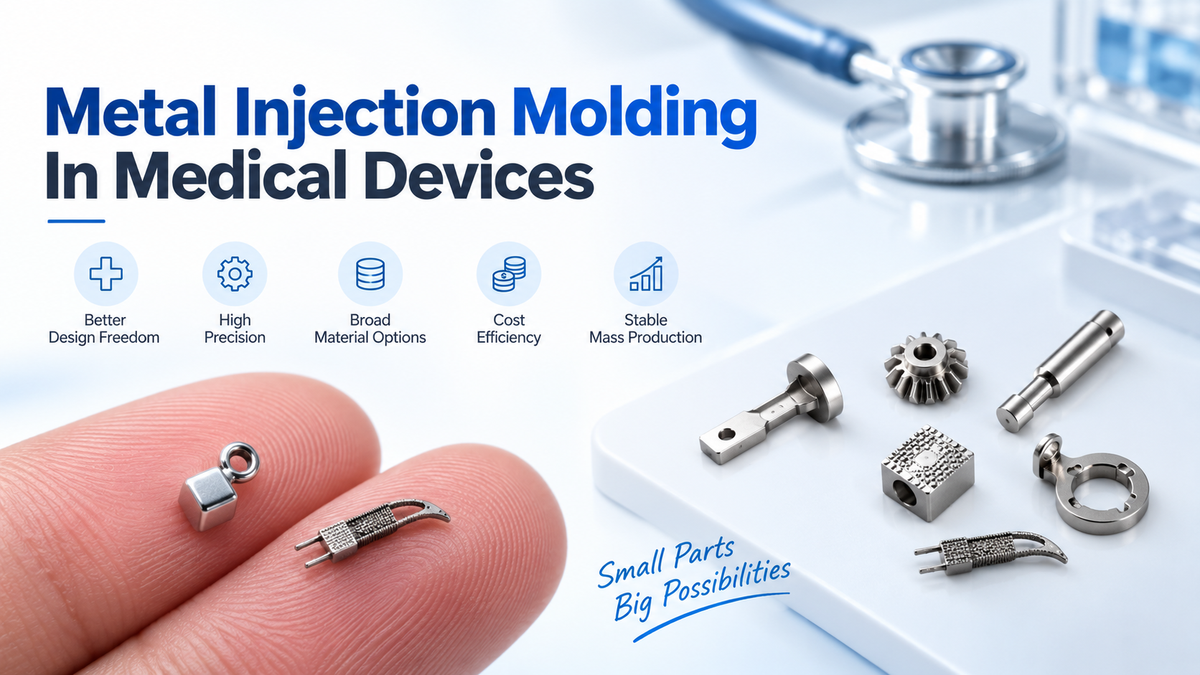
When a medical device gets smaller, the parts inside it usually become harder to make.
A surgical instrument may need a tiny moving component, a complex jaw, or a small locking mechanism that still has to work reliably after repeated use and sterilization. Making these parts from a solid metal block is possible in many cases. But as the geometry becomes smaller and more complex, some machining processes can become expensive, slow, and difficult to scale.
This is where metal injection molding (MIM) becomes useful.
MIM combines metal powder with a binder system, forms the part through injection molding, and then removes the binder and sinters the component to its final form. The process can produce small metal parts with complex geometries and good repeatability, making it particularly useful for medical device components.
The important question is not simply whether metal injection molding can make a medical part.
It is whether MIM is the right manufacturing process for that part.

Why Is MIM Useful For Medical Device Components
The value of MIM becomes clearer when you look at the parts inside a medical device.
A small surgical component may need several features at the same time, while the available space keeps getting smaller. Making all of these features from a solid piece of metal is possible with CNC machining, but the more complex the geometry becomes, the more machining operations and setup time may be needed.
Metal injection molding takes a different approach. Instead of removing most of the material from a larger block, the metal feedstock is injected into a mold and formed close to the final shape. This makes it easier to produce complex three-dimensional geometries and, in some cases, combine several features or functions into one component.
This can be particularly useful for minimally invasive surgical instruments. When an instrument needs to become smaller, its internal components have less room to work with. MIM can help form small parts with complex profiles, internal features, and tight functional interfaces without relying entirely on multiple CNC operations.
There is also a production advantage.
Once the tooling is developed, MIM can produce multiple parts in a cycle and maintain good consistency across larger production runs. The near-net-shape process also reduces the amount of material that needs to be removed compared with heavily machined parts.
For medical device manufacturers, this means MIM can be more than a way to reduce machining time. It can give engineers another way to approach part geometry, part consolidation, and production cost at the same time.

Medical Applications Of Metal Injection Molding
Metal injection molding(MIM) is already used for a range of medical and dental components, such as surgical instrument components, endoscopic parts, orthodontic components, diagnostic equipment hardware, and selected orthopedic or implant-related components.
Surgical Instruments
Surgical instruments are one of the most natural applications for MIM.
Forceps, clamps, scissors, grasper components, locking mechanisms, jaws, and other small components can contain complex three-dimensional features that are difficult to machine efficiently from bar stock.
MIM can form these features in one molding operation and reduce the amount of secondary machining.
Minimally Invasive And Endoscopic Devices
This is where the value of MIM becomes even clearer.
Endoscopic and laparoscopic instruments need to fit through very limited spaces. Components may need small holes, thin sections, articulation features, or complex mating surfaces.
As instruments become smaller, conventional machining can become increasingly difficult.
Micro metal injection molding can push this further for components where conventional MIM is still too large or too coarse.
Dental And Orthodontic Components
Metal injection molding is also used for small dental and orthodontic components where shape complexity, surface condition, strength, and production volume all matter.
For example, an orthodontic bracket with a complex shape can be produced as a single-piece micro-MIM component instead of using several small parts that need to be assembled afterward. This can simplify the part and reduce the number of assembly steps.
That is one of the reasons metal injection molding can be so useful in medical device design. Sometimes the biggest saving comes from changing the design, not simply changing the manufacturing process.
Diagnostic And Drug Delivery Components
Small metal mechanisms, housings, actuators, latches, and other precision components used in diagnostic or drug-delivery equipment can also be suitable for metal injection molding when the geometry and production volume justify the process.
Common Materials Used for Medical MIM
Material selection is one of the first things that should be reviewed.
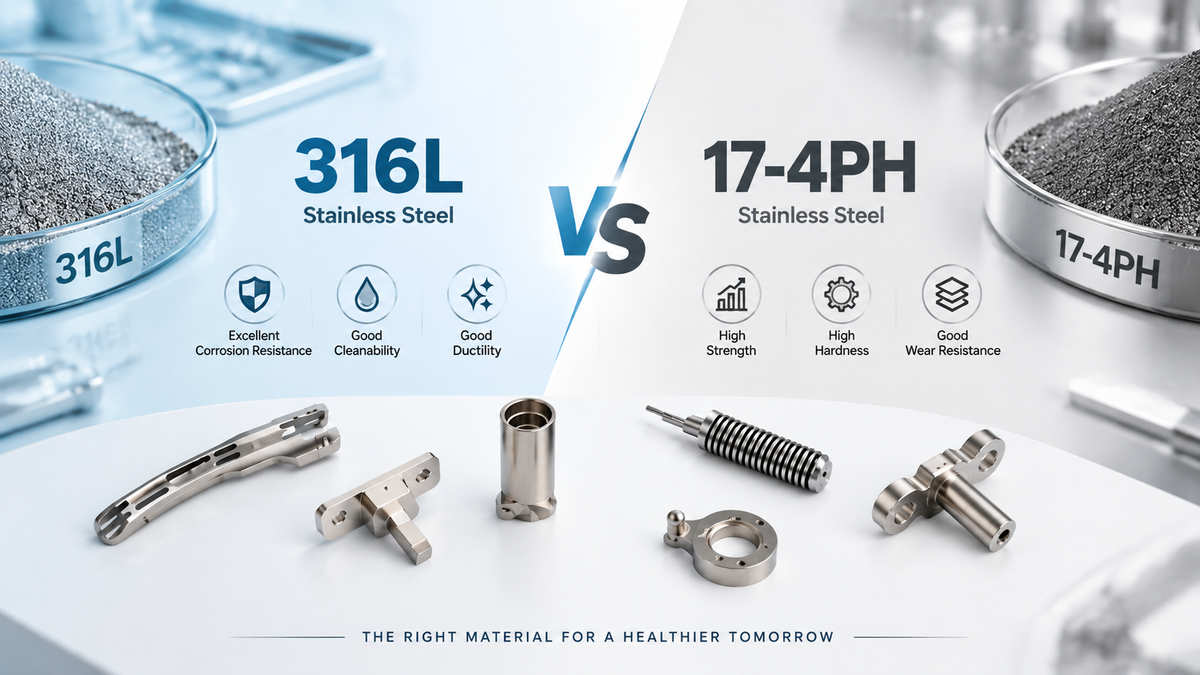
Common materials for medical MIM include stainless steels such as 316L and 17-4PH, along with selected titanium, cobalt-chrome. Different materials provide different combinations of strength, corrosion resistance, hardness, wear resistance, and biological performance.
| Material | Tensile Strength | Elongation | Hardness | Typical Reason For Selection | Typical Applications |
| 316L Stainless Steel | 480–620 MPa | 40–50% | Up To ~90 HRB | Corrosion resistance and good general performance | Surgical Instruments, Non-Implantable Components |
| 17-4PH Stainless Steel | ≥1,100 MPa | ≥10% | 38–44 HRC | Higher strength and hardness after heat treatment | Surgical Jaws, Clamps, Mechanical Components |
| Ti-6Al-4V | ≥860 MPa | ≥8% | Up To ~36 HRC | Low density, high strength-to-weight ratio, biocompatibility | Orthopedic Components, Dental Applications |
| Cobalt-Chrome (CoCrMo) | ≥800 MPa | ≥10% | Up To ~45 HRC | High strength, wear resistance and corrosion resistance | Orthopedic Components, Load-Bearing Applications |
The material options do not stop there. Depending on the application, 304L stainless steel, 420 stainless steel, 440C stainless steel, nickel-free stainless steels, nickel alloys, tungsten alloys, and other specialty materials can also be considered for MIM medical components.
For example, 420 and 440C can be considered when higher hardness and wear resistance are needed, while tungsten alloys are useful for specialized applications where high density is important.
The key is to choose the material based on the actual requirements of the medical component, rather than simply choosing the strongest or most commonly used alloy.
Micro MIM For Miniature Medical Components
As medical devices become smaller, some components become too small and detailed for conventional machining to handle efficiently. Micro Metal Injection Molding (Micro MIM) is designed for these miniature parts, including small surgical components, dental parts, and micro mechanisms.
Micro MIM is not simply about using a smaller mold. At this scale, feedstock selection, micro tooling, injection, debinding, sintering, and inspection all become more sensitive. Tiny features can also be affected by shrinkage or distortion during sintering, so process control becomes especially important.
For example, published Micro MIM capabilities include components weighing less than 1 gram and features down to around 0.0015 in, depending on the process and part design. This makes Micro MIM a useful option when a medical component needs to be both very small and highly detailed, while still requiring repeatable production.

Design Considerations For Medical MIM Parts
A good MIM part starts with a design that fits the process.
For medical components, it is worth reviewing the part geometry, material, tolerances, and secondary operations early in the project. Small changes made during the design stage can make molding more stable and reduce problems later.
Wall Thickness
Try to keep the wall thickness reasonably consistent where possible.
Large changes in section thickness can affect material flow and may lead to defects or dimensional changes during debinding and sintering. If different wall thicknesses are necessary for the function of the part, they should be reviewed during the DFM stage.
Draft And Radii
Draft angles help the part release from the mold more easily.
Small internal radii can also improve material flow and reduce sharp corners that may create tooling difficulties. The actual draft and radius requirements depend on the part geometry and mold design.
Shrinkage
MIM parts shrink during debinding and sintering.
The mold needs to account for this dimensional change from the beginning. Shrinkage is not a fixed value for every MIM part. It depends on the material, feedstock, geometry, density, and process conditions.
Holes And Threads
Many holes, slots, and threads can be formed directly during MIM.
For critical features, however, secondary machining may still be required to achieve the final dimensional or functional requirements. The key is to decide which features should be formed during molding and which should be finished afterward.
Part Consolidation
MIM can also provide more freedom to rethink the part structure.
Several small components may sometimes be combined into one molded part, reducing the number of assembly steps. But this should only be done when the new design still meets the required mechanical function, tolerance, and assembly requirements.
Surface Finish And Secondary Processing
The part is not necessarily finished when it comes out of the sintering process.
Depending on the medical application, MIM components may require CNC machining, grinding, polishing, electropolishing, passivation, heat treatment, deburring, or surface coating.
So, the design should consider the complete manufacturing process, from molding and sintering to inspection and final surface treatment, rather than looking at the MIM stage alone.
Case Study: 17-4PH Endoscopic Surgical Forceps Jaw
A useful example at XY-GLOBAL is a small 17-4PH stainless steel jaw component for an endoscopic surgical forceps.
The original process was CNC machining.
The geometry was relatively complex, and machining each individual component required a long cycle time. The part also had a lower-than-desired yield, making large-volume production difficult to control economically.
The project was then evaluated for MIM.
After tooling was developed, the component could be formed much closer to its final geometry. The injection cycle was approximately 20 seconds, and the production yield reached around 95% in the project.
The tooling added an upfront cost, but the much shorter per-part production cycle significantly reduced the manufacturing cost at production volume.
ISO 13485 In Medical MIM Manufacturing
For medical device manufacturers, material and dimensional accuracy are only part of the picture.
Process control matters just as much.
ISO 13485 is the quality management system standard specifically focused on organizations involved in medical devices and related services. For a medical component supplier, an ISO 13485-based quality system provides a structured way to control processes, documentation, quality records, supplier management, nonconformities, and traceability.
At XY-GLOBAL, we hold ISO 13485 certification. We not only produce good samples; we produce every part of every batch under the same controlled system.

MIM Vs CNC Vs PM Vs Investment Casting For Medical Parts
Metal injection molding is not automatically the best process for every medical component.
CNC machining, powder metallurgy (PM), and investment casting all have their place. The better choice depends on the part geometry, material, tolerance, production volume, and how much secondary processing is needed.

For a prototype, CNC may be the easiest place to start. For a simple pressed part, conventional powder metallurgy can make more sense. Investment casting can work well for larger and complex metal components. Metal injection molding becomes especially interesting when the part is small, complex, and needed in repeat production.
| Factor | CNC Machining | MIM | PM | Investment Casting |
| Prototype Flexibility | Excellent | More Limited | Limited | Good |
| Tooling Cost | Low | Higher | Moderate | Moderate |
| Complex 3D Geometry | Good, But Machining Time Increases | Excellent For Suitable Small Parts | More Limited | Good |
| Small Detailed Features | Excellent | Excellent | Limited | Good |
| Material Utilization | Lower For Heavily Machined Parts | High Due To Near-Net-Shape Forming | High | Generally Good |
| Production Volume | Low To Medium | Medium To High | Medium To High | Low To Medium |
| Part Consistency At Scale | Good | Very Good When Process Is Stable | Good | Good |
| Multiple Integrated Features | Possible, But May Require Several Operations | Often Easier To Form Together | More Limited | Possible |
| Secondary Machining | Usually Minimal | Sometimes Required For Critical Features | Sometimes Required | Often Required For Critical Features |
| Best Fit | Prototypes, Low Volume, Tight Local Tolerances | Small, Complex, Repeat-Production Parts | Simpler Geometries, High-Volume Parts | Larger Or Complex Cast Components |
Why Choose XY-GLOBAL For Medical MIM?
With 15+ years of precision manufacturing experience, XY-GLOBAL supports medical component projects from early design review to production. Our capabilities cover MIM, CNC machining, tooling, secondary processing, and inspection, giving customers one manufacturing partner when a part requires more than one process.
For medical MIM projects, we offer DFM support; our engineers can review material selection, part geometry, critical dimensions, surface requirements, and production volume before tooling begins. We also provide custom MIM manufacturing for medical and healthcare components.
Plus, XY-GLOBAL operates an ISO 13485-certified quality system for medical manufacturing and provides inspection and quality documentation to support medical component production. With 100+ pieces of equipment and 46+ R&D-developed materials, we can also evaluate different material and process options based on the actual application.
If you have a medical component that you are considering for MIM, send us your drawing or CAD file for a free engineering review and quote.
The Future Of MIM In Medical Device Manufacturing
Medical devices are moving in a clear direction: smaller components, more functions, and more complex mechanisms. Minimally invasive surgery is one of the main drivers, but the same trend can also be seen in miniature diagnostic equipment, drug-delivery systems, and other compact medical devices.
As these devices become smaller, Micro MIM will become more relevant. Very small components can contain multiple tiny features, making production more demanding as the size decreases. MIM can provide a practical way to produce these small and detailed metal components in repeat production.
Another important trend is part consolidation. Instead of making and assembling several small metal components, engineers can sometimes redesign them as one MIM component. This can reduce assembly steps and simplify the overall structure, which is particularly useful when space inside the medical device is limited.
Besides, simulation and digital process control are becoming more useful for complex MIM parts. They can help engineers evaluate material filling, shrinkage, and potential distortion before production tooling is completed. This is particularly valuable for miniature components, where even small dimensional changes can affect the final function.
Traceability and process documentation will also remain important in medical manufacturing. Material records, process parameters, inspection results, and production history help manufacturers maintain consistent quality and make production issues easier to identify and resolve.
Overall, the future of MIM in medical device manufacturing is not simply about making smaller parts. It is about combining miniaturization, design flexibility, process control, and reliable quality management to support the next generation of medical devices.
FAQs for Metal Injection Molding Medical Parts
1. Can MIM parts be used for sterilizable medical devices?
Yes, depending on the material, surface treatment, and application. Stainless steel MIM materials such as 316L and 17-4PH can be considered for components exposed to cleaning and sterilization processes. The material and finished part should be evaluated against the actual sterilization method and application requirements.
2. What tolerances can medical MIM achieve?
MIM can provide good dimensional consistency for many small and complex components, but the achievable tolerance depends on the material, part geometry, size, and sintering behavior. Critical dimensions should be identified during the DFM stage rather than applying one tolerance to the entire part.
3. How is MIM part quality controlled during production?
Quality control can cover the incoming material, molding, debinding, sintering, secondary processing, and final inspection stages. Depending on the project, dimensional inspection, material verification, hardness testing, surface inspection, and other checks can be included in the quality plan.
4. Can medical MIM parts be supplied with inspection documents?
Yes. Depending on the project requirements, documentation can include material certificates, dimensional inspection reports, COA, FAI, and other quality records. The required documentation can be defined before production begins.
5. How long does medical MIM tooling usually take?
Tooling time depends on part size, geometry, cavity configuration, material, and mold complexity. A DFM review is normally carried out before tooling so that potential molding and dimensional issues can be identified early.
6. What production volume makes MIM worthwhile for medical parts?
There is no fixed quantity that applies to every project. MIM generally becomes more attractive when the part has a stable design, complex geometry, and repeat production demand. Tooling cost should be evaluated together with the expected lifetime volume and unit cost.
7. Can MIM be used for a new medical device that is still in development?
Yes. MIM can be considered during the development stage, but the timing of tooling should be planned carefully. For early prototypes, other processes may be more practical, while MIM becomes more relevant once the geometry and material have been sufficiently validated for repeat production.
8. What information should I provide when asking for a medical MIM quote?
A 2D drawing or 3D CAD file, material requirement, estimated quantity, critical tolerances, surface requirements, and any known medical or quality requirements are a good starting point. If the design is still under development, sharing the intended application and expected production volume can also help the engineering team evaluate the right process.
Compartir:
Ceramic Injection Molding (CIM) for Advanced Ceramic Manufacturing