

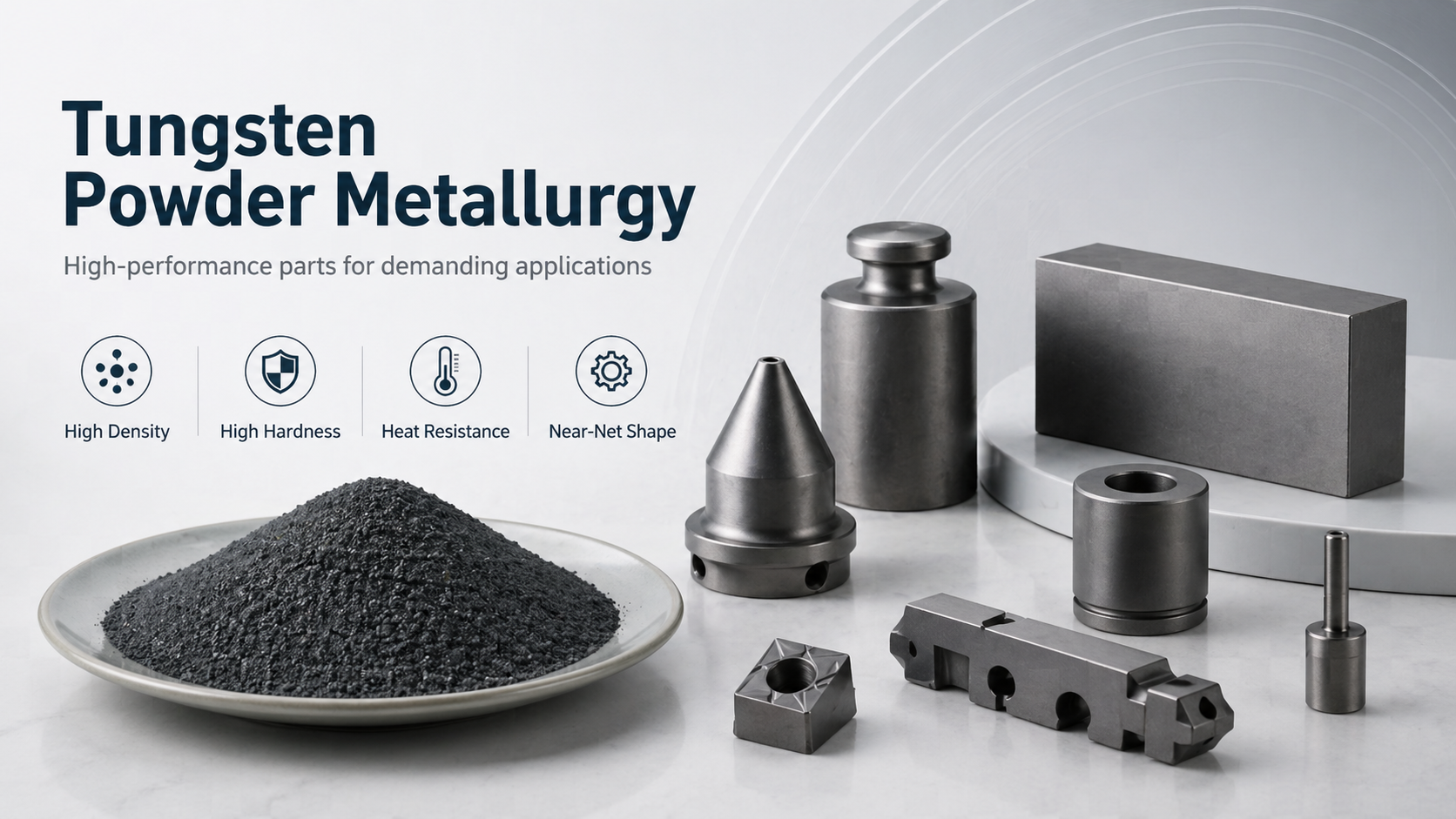

What Is Tungsten Powder Metallurgy?
Key Process Steps of Tungsten Powder Metallurgy
1. Powder Preparation
2. Compaction
3. Sintering

Advantages of Tungsten Powder Metallurgy
-
High Density & Hardness – Perfect for components requiring weight or radiation shielding.
-
Complex Geometries – Near-net-shape forming reduces the need for extensive post-machining.
-
High-Temperature Stability – Maintains performance under extreme conditions.
-
Small Batch Feasibility – Works for low-volume, high-value production runs.
| Feature | Tungsten Powder Metallurgy | Traditional Casting |
| Max Density | Very high | Moderate |
| Shape Complexity | Excellent | Limited |
| Material Waste | Low | High |
| Small Batch Cost | Moderate | High |
Disadvantages and Limitations of Tungsten Powder Metallurgy
-
High Cost – Expensive raw powder, tooling, and equipment limit it to high‑value parts.
-
Size & Shape Limits – Complex, large, or highly intricate parts are hard to press and often need extra machining.
-
Residual Porosity – Internal pores reduce strength and toughness compared with fully dense materials.
-
Sensitive Process – Small changes in powder, mixing, or sintering can cause defects or performance issues.
-
Machining Difficulty – Tungsten is hard and brittle, making finishing slow, costly, and prone to cracking.
Applications of Tungsten Powder Metallurgy
Tungsten powder metallurgy is able to produce parts that are dense, hard, wear‑resistant, and dimensionally stable, so it is used across several industries, especially in high‑performance and high‑stress applications.
High‑Density Components
Through tight control of powder composition and sintering conditions, tungsten powder metallurgy can produce counterweights, balancing blocks, radiation shields, armor penetrators that need high density and stable structure. That makes them ideal for precision balancing, radiation protection, and kinetic‑energy penetration applications in aerospace, defense, and industrial equipment.
Cutting Tools and Wear Parts
The process naturally yields hard, fine‑grained materials that resist wear, deformation, and chipping under heavy machining loads. This is why tungsten‑based powder‑metallurgy parts are widely used in carbide-tipped cutting tools, dies, and wear‑resistant components for metal forming, molding, and mining.
High‑Tech & Industrial Parts
Aerospace components like nozzles and heat shields
These parts often operate under extreme temperatures and mechanical stress, so they benefit from the high‑temperature strength and thermal stability that tungsten powder metallurgy provides.
Electronics devices such as electrodes and X‑ray targets
Here, the focus is on high electrical conductivity, good dimensional stability, and resistance to arcing and erosion, which tungsten‑based components can achieve through controlled grain size and density.
Medical devices, including surgical instruments and minimally invasive tools
In medical applications, tungsten‑based powder‑metallurgy parts are valued for their high density, chemical stability, and compatibility with surface treatments and coatings, making them suitable for high‑precision, long‑life components in surgical and diagnostic devices.
Looking Ahead: The Future of Tungsten Powder Metallurgy
XY-GLOBAL: Reliable Partner for Tungsten Powder Metallurgy
If you need high‑density, high‑hardness, high‑temperature‑resistant parts produced by tungsten powder metallurgy, XY‑GLOBAL can help turn your idea into a real part quickly. We offer a one‑stop solution from tungsten powder selection and formulation design to pressing, sintering, and post‑processing, supporting both standard and custom parts for demanding applications with strict performance requirements.
Want to know if tungsten powder metallurgy is right for your project? Feel free to contact XY‑GLOBAL for a free technical evaluation and sample support, and let us help you bring your “hard‑to‑make” parts to life.


Share:
MIM Medical Component Machining for Precision Devices
MIM vs PM: When to Choose Metal Injection Molding Over Traditional Powder Metallurgy